Saturday, January 22, 2022

Does anybody really know what time it is?

Sometimes, when you’re not paying attention, time turns soft. Its linear movement gets all loose and squishy until time is like taffy in summer. It bends, folds, curls in on itself, pushes itself up and down into humps and dips until it’s loopy as Christmas ribbon candy (the old-school kind you make yourself: ribbon candy recipe). Sometimes, time disappears completely.

I’ve been experiencing this TD (time disruption) since Mom came home from the last hospital stay. For one thing, Mom is deaf in one ear and mostly deaf in the other. She’s also lost most of her sight, especially for non-contrasty smaller detail, over the past year. If you can’t hear or see much, the distinction between day and night fizzles. So Mom, who can’t stay awake for more than an hour or so at a time, dozes and wakes at frequent intervals throughout a 24-hour period. Sometimes every hour or two. That’s a LOT of chances to wake up groggy and disoriented.


Mom will sometimes go to bed at 8 p.m., wake at 9 p.m., and be raring to get her day started. The other night she woke at 2 a.m. and called out for me. When I answered, she asked, “What time do they serve meals in this place?” Sometimes she wakes, clear as a bell, and on a mission: “We have to change those sheets on the guest bed,” or “Will you help me write a letter?” But it’s 4:30 a.m., and she’s already been up every 1 ½ hours since 10 p.m. Our body clocks’ hands are spinning like pinwheels.

This current bout of TD might also have to do with our kitchen’s missing calendar. We’ve always had a BIG PRINT write-on calendar on the wall, that Ray got each year from work. But now that he’s retired, we have only a normal pale, small-print thing. You can’t see it at all once you’re 6 feet away, so essentially, time does not exist.

Another cause of this TD has to do, I think, with my current lack of social cues. I’ve been out of the house only once since December 30 (and that was a quick trip to Walmart, which doesn’t really count), and without my normal human contact and time clues—downtown errands, Good Old Irish Walks, Friday service at Our Lady of Little Town Watering Hole, coffee at a friend’s, work (retirement contributes to TD), etc.—I can’t keep days & dates straight. It’s always Tuesday. Or Sunday. It’s always time to cook. Or clean the bathroom.
I’m kind of hermit-y anyway, so this last dilemma doesn’t bother me SO much. But this has been a loooong stretch of hermitude, even for me, and my fear is that if it goes on long enough, I’ll stop brushing my hair, my nails will grow into thick claws, I’ll put blackout blinds on the windows and increasingly avoid the light, my eyes will get huge and buggy, my skin will turn the color of bleached linen, and I’ll become just a bizarre Little Town urban myth.

Today, I think I’ll try to knit a bit and watch some TV news. (They'll give me the date, right?) I’ve got a couple hats I’d like to finish, and heck, I have all the no-time in the world…

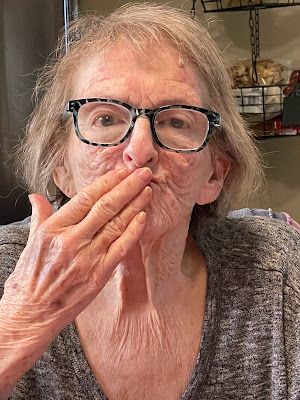
Blowing you all a kiss...


Monday, January 17, 2022

Our Rallying Cries (and Laughs)

Ozark cabin camping: Mom is younger here than my oldest son is now.

When my grandma was home in hospice care, having stopped all the treatments, therapies, and hospitalizations for stomach cancer, she would sometimes seem to be getting better. We called these “rallies” and joked that we could never count Grandma out because she had an uncanny way of rallying.

Mom seems to be rallying right now. Suddenly, in the past couple of days, she has a voracious appetite. My mother has three of her own teeth left, all of them sweet, and she won’t wear her ill-fitting dentures anymore. I’ve told her she’s on the “whatever you want” diet, so she’s only eating tapioca, sherbet, Jell-O, sherbet, butterscotch pudding, and sherbet (a huge bowl of rainbow sherbet, drizzled and softened with orange juice, must end every meal – all between-meal snacks are bowls of sherbet). And my daughter just brought us her partner’s garlic mashed potatoes and her Swiss chocolate cupcakes with cheesecake mousse, so guess who else is on the “whatever you want” diet?

Mom seems stronger right now, too. She’s fallen quite a few times in the past year, so we attached a portable doorbell ringer to her walker, put the receiver in the living room, and she’s supposed to ring the bell whenever she wants to get up. She’s not supposed to go anywhere without ringing the bell. But yesterday morning, at 2:45 a.m., I woke to canaries chirping because all the kitchen lights were on. I snuck off the sofa and found Mom in the kitchen, peering into the freezer, on the hunt for sherbet I’m guessing. No walker nearby. Then at 5 a.m., same thing: All lights on, canaries going to town, Mom in the bathroom. No walker. She’s been getting herself up and back to bed without my help (or knowledge probably, sometimes). Part of me is already planning for an elaborate bed alarm system. Part of me wants to cheer her on.

Then, at breakfast, a fleeting reminder that all is not well: She asked me who all the little girls running around the house were, and whether or not I was ever planning to tell her the truth, that they were in trouble with Joe Cook (I don’t know anyone with this name).

I guess my point in all this is that dying isn’t an either/or, white/black, or a steady, predictable decline. There’s no line graph for this trajectory. It’s a jagged rollercoaster of rallies and relapses. It’s good nights, with 4-hour stretches of glorious sleep, and bad nights of being up every hour. It’s Mom rising to the surface to recall hilarious moments from our camping trip to the Ozarks in 1979, then drifting into the ether where little girls and men named Joe Cook float around.

This terrifying, fascinating process of dying, it seems, is giving me the ultimate practice at “going with the flow.” I have to be here now, where expectations regularly go up in sleepless smoke, where Mom and I crack up together in unexpected moments of joy, and where all we can really count on is the present moment.

Thursday, January 13, 2022

The Caretaker Conundrum


I’m my mother’s caretaker and her only daughter. I have three brothers, all close to my age, and they’ve been really wonderful in this process of caring for Mom more intensely over that past few months. They all live out of state, some farther than others, and all of them have come to spend time with Mom. They’ve provided dinners, helped rearrange furniture, helped sort through things, provided respite for me by spending time with Mom while I shower or nap, and so much more. They’ve ferried nieces and grand nieces & nephews from afar to visit, and any of them would do anything they could to help. I have one daughter (I should have had four more) who would do anything for her grandma, but she’s juggling two young kids and a newish baby of her own right now. I have two sons and a stepson, and they would also do anything they could for their grandma.

The thing my brothers and sons can’t do is help Mom in the bathroom. She is aware enough to hold tight to her pride & dignity as much as she can, and she won’t allow men to help her beyond that bathroom door. But she does need help. So I’m it, 24/7, ’round the clock, unless a hospice aide is here. And that reminds me of this funny, sad, true, brilliant poem by my friend Lindy Obach, first published in The Briar Cliff Review. It's good advice, people.

Have a Daughter

If you don’t have a daughter, you better hope to God you
don’t get sick. You should pray for a quick death,
a car accident, maybe, a blood vessel
bursting in your brain.
Or an easy death, in your warm bed, after 86
healthy, active years.
Sons can deal with that.
Sons can use warm, soothing voices,
and sometimes, sons can make phone calls.
But don’t get sick. Don’t need
someone to wash your soiled pajamas
because a son will not do that.
A son will not swipe deodorant under your weak arms,
a son will not pick up your prescription
of Vagifem. A son will not take off your old bra
and get you in the shower.
Have a daughter. A daughter will curse you,
will scream at you to get your pants on,
will haul you up off the closet floor,
will hate you, will take your face
in her palms and cry, will think it’s easier
if you die.
Have a daughter.
A daughter will splinter open her life
trying to save yours.

Tuesday, January 11, 2022

Into the Mystery

One of the symptoms of my mother’s illness is that her healthy blood cells are being replaced by proliferating white cells, and not the good kind. This can lead to anemia, infections, and low blood oxygen. It’s this last one I blame for Mom’s “visions,” as she calls them, but it could also be the dying process in general—one foot on either side of the thin veil.

My mother has always had a blurry line between dreaming and waking. She talks and laughs in her sleep, her hands wave & gesture & work, and when she wakes, she’s sure what she dreamed has really happened.

Now, however, even that blurry line is gone. Waking and dreaming are one fluid, undulating space. Memories come in waves, some from the smallest details of her life 70 or more years ago. When she’s able to sit at the kitchen table, I can see on her face the almost-excruciating concentration it takes her to hold herself in the present moment. It exhausts her. Sometimes she can’t do it, and she drifts into that timeless liquid space again.

When she loses her tenuous hold, language leaves her too. This is especially hard for her, a person for whom language has been a matter of pride—until this last hospital stay, she was a constant, voracious reader. She wrote poems. She regularly beat us all at Scrabble, then re-told stories of her victories for days. But in this new life, things are sometimes renamed: Sherbet becomes “shaggy”; a velvet sweat suit she wants to wear becomes “furry elegance”; she scrunches up her brow, quietly mumbles a couple tries, then gives up trying to remember “coffee”. But then, when I ask her how she feels one morning, she rises to the surface and her wit returns: “Just ducky,” she says.

My mother’s emotional landscape is fuzzy now too. She can go from weeping and tender to anxious and angry in a sudden, sharp u-turn that defies understanding. She laughs in her sleep. Or yells. Or begs. One night, she asked me to lie down with her and keep her safe, and when I did, she said, “Get up. You’re crushing me,” though we weren’t touching. One minute she’ll say I’m starving her and waiting for her to die, and the next minute she’ll cling to my arm, telling me over and over how much she loves me. Sometimes silence is the only thing that will settle her. Sometimes silence terrifies her. I know this is all the filters dissolving. I’m learning not to be jarred or hurt by anything she says, and I’m learning when to respond and when to keep still.

The visions can sometimes be alarming. In recent days, she thought someone was making noise in her closet; she thought someone was trying to open the back door in the middle of the night; she thought nine women were in her room having dinner. She saw a man sitting in her rocking chair and sat up in bed to ask him, “Sir, will you please turn on the light?” She scolded me for spending every night at the bar (she often thought the nurses in the hospital were drinking and smoking down the hall late at night). She told me she needed to get “out of this place to somewhere where they’ll take care of me” (I wouldn’t get up at 4 a.m. to bring her sherbet). At 3 a.m. one morning, I found her at the kitchen table with all the lights on, waiting for someone to bring her sherbet. No cane, no walker. It’s a miracle she didn’t fall. Yesterday morning, after a particularly good night’s sleep (a record 5-hour stretch), she said a little girl woke her up, saying “Welcome, welcome!”

I believe much of what’s happening right now is her nervous system unraveling. I believe it’s biology and chemistry. But, some idealistic child in me hopes these night visitors are angels, spirit guides, or loved ones gone before her, come to comfort her and help her find her way through the veil. And in truth, in spite of science, in spite of the fact that everyone who’s ever lived has or will die, no one really knows what’s on the other side. For my mom, who is not religious and has always pooh-poohed most belief systems, this mystery may be the hardest part of the process.

Wednesday, January 5, 2022

What Death is Trying to Teach Me

TW: This post is about dying and death.

My mother, whose body is in the process of letting her go, is in hospice care at home now. I’m her only daughter and primary caregiver, and I’m sleeping in a recliner in our living room, so I can be closer in order to help her with nighttime bathroom trips. Yes, it’s exhausting: Sometimes, I wake at 3 a.m. when my body says it’s been too long since I’ve heard the bell she rings for my help. I sneak in and check her, then I go back to the chair and lie awake, waiting again for the bell. But however hard this is, it will end, sooner than I want. So I thank my lucky stars that (a) I have the privilege of sharing this sacred space and time with her, and (b) that I’m aware enough to KNOW what a sacred time this is.

One thing my mother’s passage is teaching me is that the dying process, like all deep loss and sorrow, strips away pretense. If we are lucky enough and conscious enough to be present with someone in this time, we see their true humanity. We see them naked—physically and emotionally—unadorned. We see their unvarnished, unprotected, almost child-like fears. We see their vulnerability, pain, and love (and we see the ways pain and fear can sometimes twist love into odd shapes).

Another important thing I’m learning (this is trickier) is to let go. My mother and I are alike in many ways, but in other fundamental ways, we’re polar opposites. This has led to a sometimes tense relationship over the years, especially in the last 6-7 years since we chose to live together, knowing that her cancer, a blood cancer called CLL (my mom is the 4th family member to deal with this) would mean increasing levels of care. I was lucky enough to be around as Mom took care of my grandma, at home, at the end of her life. I knew then, and I still know in spite of the difficulties, that if it’s possible for someone to die at home, it’s a gift. But my desire to make this possible for my mother, means I’ve had to let go of resentments, injuries, insults, etc. I was (stubbornly) holding onto—I can’t hold onto these, and hold my mother in compassion at the same time.

Side note: I’m not naïve. I know that for some people who logistically COULD care for a dying person at home, there may be injuries that are too great, too deep, too unforgiveable. I know not everyone can or should go down this road.

I’m learning to let go in another way, too. I’m a person for whom control is comfort. I’m most comfortable if I feel things are organized, categorized, understood. The dying process is constantly slapping my silly illusion of control right out of my hands. It's balled up my useless pride and replaced it with humility, as I let go of my avoidance of germs, bodily fluids, and unpleasantness. I’m learning to accept without judgement or analysis. In learning to face uncertainty, embrace the most basic kind of intimacies, and be fully present for my mother, I’m learning to be present, period.

I’m also daily having to let go of my former mothers—my strong mother, my powerful mother, my entertaining mother, my invincible mother. I’m learning to embrace my mother as she becomes someone new each day, someone weaker, more afraid, more distant, most human.

End note: Another way in which I’m not naïve is that this process of my mother’s leaving progressed very slowly, for a very long time. Years, in fact. Then suddenly, in the space of 3-4 months, it ramped up to hyperspeed. So I understand that I’m operating on a kind of detached autopilot right now—there are things that have to get done, and I have to do them. This means I’ve poured my emotional responses to all this into what Jung called the “basement,” where it will eventually crack the concrete and flood the entire house. But for now, I’m in the “mobilize” lifeboat. I’m able to look at Mom’s dying reasonably. To write about it. To patiently wait for the next bell.


Wednesday, December 15, 2021

Less Whining, More Truthing

This sounds like a bad made-for-TV movie plot, but honest, it’s one of those “truth is stranger than fiction” stories…

This past fall, my aging, ill, live-in mother, for whom I’m primary caregiver, was hospitalized. It was pretty serious stuff, but her healthcare providers were brilliant, socialism (Medicare) made such medical care possible, and my mother is one determined human being. She spent a week in the hospital and came home, weak and exhausted but on the mend. For the next month, I coordinated meds, weekly visits from three home healthcare workers, follow-up medical appointments, and weekly labs.

Then, just before Thanksgiving, Ray had another heart attack, his 4th, thanks to rotten cholesterol/heart genes and probably a couple decades of road-musician food. We went to our Little Town ER in the wee hours, where there was no cardiologist either on duty or on call, and where he was treated and released because a telehealth cardiologist said his echocardiogram looked okay (and because the Big City hospitals are at capacity). But about 24 hours later, with the heart attack still ongoing, I drove him to the ER of a heart hospital in the Big City, where he was admitted. (A Little Town ER doc had hinted that if you show up in an ER, they have to see you – that doc thought Ray should have been airlifted to the Big City hospital.) You can read a bit about our Big City adventure here: https://uncanneryrow.blogspot.com/2021/11/the-heart-of-gratitude.html.

Thankfully for all, Mom was spending Thanksgiving with my brothers in a lovely southern location when this happened, so I was free to divide my time between zookeeping here at the Uncannery Row Refuge for All Creatures Haired, Furred, and Feathered, and daily commutes to visit Ray in the Big City. A few more days of hospital living and much more gratitude for brilliant healthcare providers and our socialist Medicare system later, I brought Ray home. He didn’t need a LOT of help when he came home, but he couldn’t exert himself or lift anything over 10 lbs., and he was exhausted, so I found myself caregiving again.

Then, two days after Mom came home, while Ray was still home and beginning rehab at our Little Town hospital, Mom went back into the hospital – our Little Town hospital this time – with new, scary stuff. Another week of hospital life, an almost overwhelming amount of gratitude, and Mom came home again, with new meds and more intensive caregiving requirements.

I remember someone commenting, somewhere during these adventures, that they didn’t know how I could do it all. My answer was that I’m really good at calmly rising to the occasion, but that I sometimes fall apart later, once the crisis is averted. I won’t say I’m prophetic, but a day after Mom got home from her second hospital stay, I woke up with a respiratory plague that turned out to be two weeks of bronchitis (probably – I wasn’t ABOUT to go to the doc and end up Hospital Patient #3). Mom and I both had negative Covid tests during this time, so I knew what I had was likely a run-of-the-mill plague.

For the next little while, the three of us took care of each other. Dear friends gave us porch drop-off’s of dinner rolls, soup, and elderberry syrup, and we isolated. I’ll admit that during my illness (finally letting up now), I may have felt just a wee bit sorry for myself. I may have been a little whiny once or twice. And I may have sent Heart Attack Guy out for groceries and more NyQuil.

But I read something today that shifted things back in perspective for me. It was an article by Toni Bernhard, former law professor, person living with chronic illness, and author of How to Be Sick: A Buddhist-Inspired Guide for the Chronically Ill and Their Caregivers, where she talks about understanding illness from a Buddhist perspective. The article (read the whole article here: https://www.lionsroar.com/illness-and-the-buddhas-prescription/) helped me re-frame my thinking about our household’s recent illnesses, but it also helped me to re-center my thinking about suffering, and life in general, by reminding me of the Four Noble Truths, the foundation of Buddhism:

1. All life is suffering. It is a fact, Buddha reminds us, that ALL humans go through non-pleasant experiences: birth, pain, illness, aging, grief, wanting what we don’t have, not wanting what we have, losing what we cherish.

2. Dukkha is the cause of suffering. In the original language of Buddhist texts, the word usually translated as suffering is dukkha, but its meaning is closer to an amalgamation of dissatisfaction, discomfort, stress, unease. And here was Bernard’s commentary about this Noble Truth, and the re-centering revelation for me: It isn’t the “ten thousand sorrows” of human existence – the experiences themselves – that cause our suffering; it’s our own inability to accept their reality as a normal, expected part of life that causes it. It's our misguided expectation that we should/could always be “happy” that causes our suffering.

3. Suffering can be overcome. By fully comprehending the reality of suffering as part of life, we can end our dis-ease.

4. The eightfold path is the way to overcome suffering. The eightfold path is Buddha’s teaching about HOW to KNOW (not just understand intellectually, but KNOW) the nature of reality by living “correctly” (probably also a mistranslation, but you can read more about the eightfold path here: https://www.lionsroar.com/what-is-eightfold-path/).

So today, on Mom’s 86th birthday, I’m caretaking, coughing and blowing my nose ad infinitum, throwing down the Emergen-C, sanitizing like a madwoman, and feeling a lot less sorry for myself. I’m accepting my own illness as a normal part of my life – I don’t have to LIKE it, just ACCEPT it – and learning what I can from it, maybe about my own limitations, my stubbornness when it comes to taking care of the caretaker, and the healing properties of Doritos and French onion dip, in moderation of course.

The Four Noble Truths


Tuesday, November 23, 2021

The Heart of Gratitude

Thanksgiving Synchronicities. Wow. I’m sitting in the waiting room at the Heart Hospital while Ray’s getting his fluids topped off through a femoral artery. We’ve been through this before, so I’m worried but not panicking. This is his 3rd heart attack, 4th if we count the time we got here just early enough to head it off with another stent. He’s a pretty fit, active, non-smoking guy, still working past his retirement age, who eats a healthy diet of mostly unprocessed, home-cooked food. But he has a genetic history of heart disease and high cholesterol, and he probably has some damage from his earlier life as a smoking, fast-food-eating road musician. Anyway, we ignored the medical advice of our Little Town ER doc to go home and follow up with a cardiologist in December, and we drove ourselves here to the Big City in time. Again. 

So I’m sitting here, and I must have my invisible I WILL LISTEN sign flashing, because an older man sitting across from me says, “Where are you from?” I tell him, then he starts talking. He doesn’t stop for at least 30 minutes. He tells me everything about his life—his wife’s dementia and recent falls, the blood clot they’re blasting in her, their kids and grandkids and where every one of them lives and what they do, his and his wife’s childhoods (they went to different schools in the same town…their birthdays are two days apart…they’re both 78), his military service, his career as a buildings and maintenance specialist with Indian Health Service.

Then he tells me about his family growing up: his white father, his Native mother, his siblings. Then he tells me about how his mother had been sent to the Indian boarding school in Pine Ridge as a kid, and how, when she was 16 and operating the mangle (a giant industrial hot roller machine, like the Godzilla version of rollers on old wringer-washers), she lost her left hand in the machine, and how he could still see her, diaper pins in her teeth, diapering his baby brother one-handed, and how, because of her, he and his wife and kids got free Covid vaccines and boosters at IHS.

I’m mostly silent, with a nod or a “wow,” now and then, and I’m grateful that I can give him this space to talk. Finally, he says he should probably get back upstairs to his wife, and I say, “We have a lot to be thankful for, don’t we.” And I really mean that. We DO have a lot to be thankful for. We are both going to leave the Heart Hospital with the people we love.

But I’m also a little stunned by his story, thinking again of the girls and women of the Magdalene laundries, and what so many of them, like this man’s mother, may have lost to the mangles, the ironing machines, the industry and cruelty of institutions that take children away and lock them up. I’m also thinking that we cruel humans seem determined to make Magdalenes wherever we go.

Today, Ray is home and resting. That he’s here is a testament to the brilliance of modern medicine, to compassionate, skilled caregivers, to our willingness to trust our own intuition, and maybe mostly, to the miracles of the human body—as one arterial branch in Ray’s heart clogged, shut down, and died, his heart was already busy making a new branch to replace it.

This Thanksgiving, we will have to miss an epic family gathering in a lovely southern location, with four generations of family, including my 80-something mom, all my siblings, and their partners and kids. I will miss the Bailey’s and eggnog, the dominoes, the moons over the lake, the cut-throat Scrabble matches, the singing, laughing, and non-stop grazing. Still, I’m SO grateful they can gather, that they can Zoom/Skype/Facetime (so we can witness the mayhem), and that Ray and I will be here together to appreciate life, this unending, unfolding trail of miracles.